
Étudiante
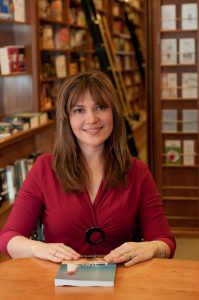
Adriana’s commitment to human rights and social justice is informed by her experience growing up in Colombia amidst extreme political and social unrest and by her engagement in leadership positions around the world.
Adriana Cabrera Cleves is a museologist and researcher with extensive international experience. She is a Ph.D. researcher in the Social and Cultural Analysis program, Anthropology and Sociology Department, at Concordia University, Tiohtià:ke-Montréal, unceded Kanien’kehá:ka territory (Canada). She holds an M.A. in Museology from the Amsterdam University of the Arts-Reinwardt Academy (Netherlands), specializing in peace and reconciliation, along with graduate specializations in Business Administration (Victoria University, Canada) and Cultural Management (Universidad del Rosario, Colombia), a Diploma in French Civilisation, Sorbonne (France), and a B.A. in Social Communication and Journalism (Universidad Javeriana, Colombia).
In her 25 years of work experience in the museum field, Adriana created and directed the Department of Communications at the National Museum of Colombia and served as Associate Vice-President of Cultural Programs at the Museum of Latin American Art in Los Angeles, California. In Canada, her work has included positions at the Royal British Columbia Museum; collaboration with the first international exhibition of Chile’s Museum of Memory and Human Rights in Montreal; curation of the Temporary Museum of Memory and Solidarity with the Colombian community in Quebec (COHDS); co-curation of the exhibition Images and Power: Black Women; research on social justice and human rights exhibitions at the McCord Museum; and consulting services to the Montreal Holocaust Museum. She has also taught exhibitions and public programs development at the University of San Diego (USA) and served as instructor of Leadership Workshops at the Graduate Professional Skills Program, Concordia University (Canada).
Early in her research career, Adriana worked as a radio news writer and presenter for the Radiodifusora Nacional program of the Council of Human Rights of the Presidency of Colombia, and collaborated as a researcher at the International School of Peace Negotiations in Amsterdam. In 2000, she presented her M.A. research project on memory and identity construction, titled Museology of Peace and Reconciliation for Colombia through Indigenous Intangible Spiritual Heritage, with Dr. Peter van Mensch as research adviser, at the international museology course The Role of Museums in the Development of Peace and Tolerance in Dubrovnik, Croatia, organized by Dr. Martin Segger (University of Victoria) and Dr. Ivo Maroević (University of Zagreb). In 2002, this research was presented as cutting-edge work at the International Council of Museums (ICOM) in Paris by Dr. Piet Pouw, former ICOM Interim Secretary-General.
In 2013, Adriana joined the Human Rights Museology research group directed by Dr. Jennifer Carter at the Université du Québec à Montréal, contributing to research on the Museum of Memory and Human Rights of Chile and the Canadian Museum of Human Rights. In 2017, at Concordia University’s Ethnography Lab, she co-initiated a Working Group devoted to researching Human Rights, whose first project examined the ethnography of the McCord Museum’s approach to human rights in the exhibition Shalom Montreal. She has since participated as author and co-author of various publications and lectured at international conferences.
Building on this trajectory, Adriana’s current doctoral research examines the political economy of algorithmic governance through the lens of decolonial museology, asking how decentralized technologies such as blockchain and DAOs might function as alternative infrastructures for community-led Indigenous sovereignty over cultural data, archives, treaty relationships, and economic resources, moving beyond symbolic models of reconciliation toward structures of governance and technological self-determination.

