
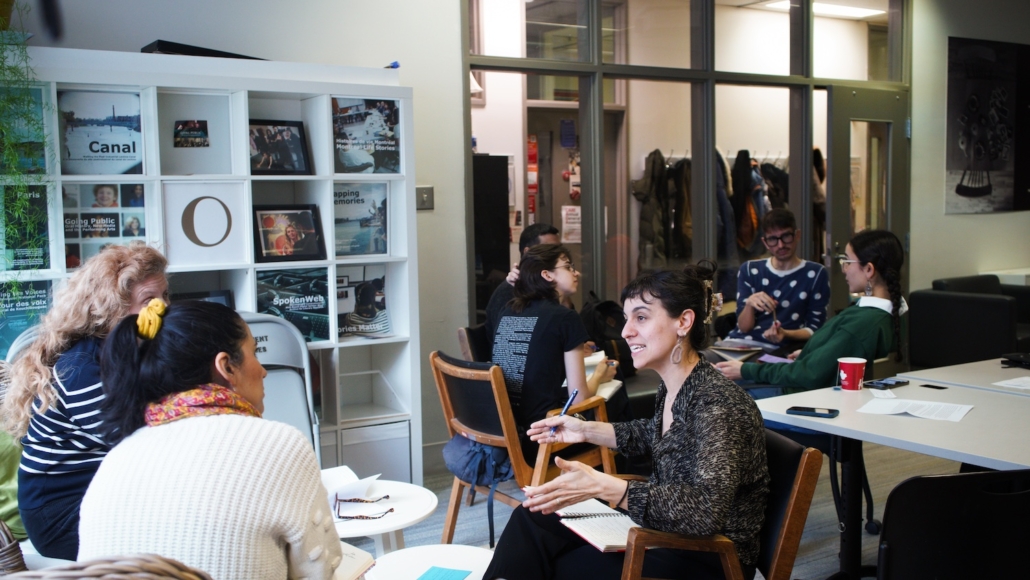
Oral history is becoming a popular tool for classroom learning as it offers students the chance to connect with the past in hand-on and interconnected ways. Should you be interested in introducing oral history to your classroom or community group, below you will find different ways to do so and information on how COHDS can help you do so.
COHDS WORKSHOPS
A good place to begin are the 30-40 workshops offered in oral history methodology, theory and ethics at COHDS each year. These workshops are offered by COHDS leadership and staff, as well as by affiliated members who share their skills and insights with one another. There is a great deal of cross-disciplinary fertilization that results.
COHDS SUMMER INSTITUTES
Graduate students at COHDS also have the option of enrolling in an intensive Concordia University Summer Institute taught by a faculty member affiliated with our research unit. These two-or-three week oral history intensive courses are offered in the home discipline of the instructor but are held at COHDS with substantial staff support.
COHDS Scholars in Residence Program
Graduate students affiliated with COHDS can also apply to become a member of our annual cohort of “Scholars in Residence”, a special designation that forges connection between emerging oral historians across disciplines. Among other things, they put their intellectual stamp on our annual Emerging Scholars Symposium.
Tethered Courses
From time to time, COHDS faculty teach across disciplinary boundaries by “tethering” their courses to each other. In past years, theatre and history courses were tethered in a full year “oral history and performance” framework. Other years, courses in theatre, art education, art history and history were scheduled together as part of the “Right to the City” pedagogical initiative where students based themselves in a working-class neighbourhood in Montreal. Other tandems have included Geography and History as well as Theatre and Applied Human Sciences.
Reading Courses/PhD Fields
Many graduate students affiliated with COHDS are enrolled in Concordia’s Humanities and Individualized PhD programs at Concordia, which enable them to forge a cross-disciplinary approach to oral history. Those interested in applying to these programs would be well served by looking at the faculty profiles on this website when putting together their supervisory committee. COHDS faculty have taught one of the compulsory courses for Humanities PhD program on a number of occasions. Our extended list of affiliated faculty members at other Quebec universities offers other possibilities.
Graduate and undergraduate students in most programs can also approach COHDS affiliated faculty directly to see if they would be willing to supervise a reading course/tutorial in an aspect of oral history or a Major or Minor PhD field in some aspect of oral history.
Oral History Courses in Disciplinary Programs at Concordia
Most COHDS affiliated faculty teach courses of direct relevance to oral historians. These vary from year to year and program to program. Here are a few examples:
Department of History
Concordia University’s Department of History offers a number of oral history courses at the graduate and master’s levels. History PhD students also have the option of a Minor or Major PhD field in Oral History, Public History, or related fields.
- HIST 200 Histories of Nightlife (VK Preston)
- HIST 388 Oral History and Creative Practice (Multiple COHDS faculty)
This course is an introduction to oral history theory, ethics, and practice, and surveys the many oral history projects underway in Montreal and around the globe. It often focuses on how to interpret and listen to already archived interviews.
- HIST 390 Urban History Laboratory (Multiple COHDS faculty)
Students conduct original archival and/or oral history research on a selected aspect of Montreal’s history and then go public with their research in creative and engaging ways.
- HIST 306 History and the Public (Multiple COHDS faculty)
This course is an examination of the practice of history outside the academy and an introduction to the critical analysis of presentations of history in public and popular culture. Topics include archives, corporate and popular history, museums and historic sites, preservation, film and television, theme parks, and anniversary commemorations.
- HIST 380: History and Digital Media (Elena Razlogova)
This course offers an introduction to the changes that new media and technologies are bringing to historical research, writing, presentation, and teaching of the past. The course begins with an overview of the history of the Internet and digital media, and then examines historical work on a variety of subjects — by scholars, teachers, archivists, museum curators, and popular historians — published on the Web. Historical and critical readings provide the basis for the hands-on section of the course in which students develop a pilot history podcast.
- HIST 485/A – Children, Youth, and War (Public History Workshop) (Barbara Lorenzkowski)
- HIST 481/665 Advanced Study in Public History: Oral History (Multiple COHDS faculty)
This undergraduate/graduate course will introduce students to oral history methodology, theory and ethics. You will have the opportunity to design your own research-creation project, go through ethics, interview, transcribe, database, and interpret oral history.
- HIST485/665. Podcasting: History and Practice (Elena Razloglova)
This course provides an introduction to the history and practice of podcasting. The course begins with a brief overview of storytelling in aural form, from the history of radio and sound recording to the birth of podcasting in the twenty-first-century. Historical and critical readings provide the basis for the hands-on section of the course, including workshops on sound recording, editing, scriptwriting, and incorporating interviews, music, and sound effects. During each class, we dissect award-winning nonfiction podcast series, including Serial (true crime), 99% invisible (design), The Dig (labor and radicalism), Have You Heard George’s Podcast? (Africa), Sexing History (gender and sexuality), More Perfect (law) and others. The course includes guest lectures by several practitioners, including, in the past, Bill Siemering, who drafted and enacted the first mission document at National Public Radio (NPR in the US) in the early 1970s. During the course, students develop a pilot history podcast. For their podcasts, students can revise an academic paper written for another class or experiment with a new project.
Affiliated COHDS faculty include Barbara Lorenzkowski, Désirée Rochat, Elena Razlogova, Alison Rowley, Mike Ferguson, VK Preston, Yuan Yi, Anna Sheftel, Matthew Penney, Gavin Foster, and Steven High.
Department of Theatre
Concordia University’s Department of Theatre offers the Oral History Performance course and one on Documentary Theatre, both are heavily informed by oral history practices.
Affiliated COHDS faculty include Luis Sotelo Castro and Shauna Janssen
PLAN A CLASS/GROUP VISIT
For those interested in familiarizing themselves with our spaces and technologies available, COHDS offers both tours of our spaces as well as digital storytelling workshops.These workshops are meant to introduce students to archiving and interview practices and provide hands-on learning opportunities.
We have previously welcomed highschool students, CEGEP and university groups, as well as community groups. Please note that student cohorts do not have to be affiliated with a history department, as we welcome students and faculty from across disciplines.
Should you wish to bring your class to COHDS, please contact: cohds.chorn@concordia.ca
Oral historian and co-founder of COHDS Dr. Steven High is also able for class visits and workshops on oral history training and methodology. You can contact Dr. High at: steven.high@concordia.ca
Throughout the school year COHDS also offers a plethora of workshops for those who wish to learn more about research creation and oral history. Workshops are open to all and have included audio and video recording how-tos, interview conducting, ethics, queer oral history, archival practices, and more. You can stay up to date with upcoming workshops here.
Classroom Resources

Storytelling in the Classroom: A Path to Deeper Learning
COHDS has partnered with the Decolonial Perspectives and Practices Hub (DPPH) to provide tools to incorporate storytelling into the classroom. Bring oral histories into your classroom by integrating the DPPH educational videos covering diverse themes related to race and identity, addressing discrimination, institutional change, disability justice, intersectionality, anti-racism and more. The educational videos highlight the lived experiences of students, educators and community organizers.
Each video includes a course guide with tailored reflection exercises, discussion questions, recommended assignments and readings. These guides outline simple steps to facilitate meaningful student engagement and provide educators with the tools to make essential conversations on race, identity, and inclusion accessible, transformative, and impactful.