

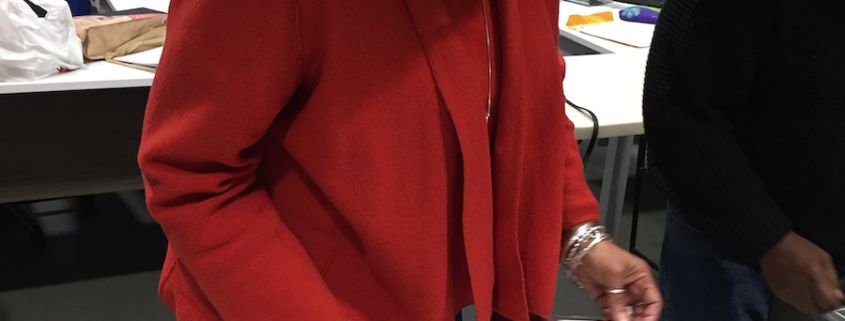
Photo description: Marjorie Villefranche in a collective oral history interview at La Maison d’Haïti
With Philippe Blouin, Michael Ferguson, Cassandra Marsillo, Tesfa Peterson, Léa Denieul Pinsky, and Désirée Rochat
This conversation explores a central topic: How do oral historians navigate the web of relationships that tie them to the community they are working with?
Over many years, the six panelists have worked closely with the Mohawk Mothers and Duplessis Orphans (Philippe Blouin & Léa Denieul Pinsky); a Lebanese community in Leamington, Ontario that has maintained deep connection to its homeland (Michael Ferguson); Molisan Italian-Canadians in Montreal, who are telling stories about immigration, identity, collective memory, food, and folklore (Cassandra Marsillo); the Institute for People’s Enlightenment in the Grenadian village of LaDigue that cultivates inclusive and intergenerational spaces for learning (Tesfa Peterson); and Black communities in Quebec whose knowledge activism has generated practices of community archiving and popular pedagogy.
Some of the panelists are members of the communities they study; others have been welcomed into the community. Yet, for all panelists, relationality lies at the core of their commitment to non-extractivist research. Their research affords an extended contemplation of the principle of “Shared Authority,” so foundational to our work at COHDS. In essence, they write, we are reflecting on what we are doing to try and “make oral history a more democratic cultural practice.” (Zembrzycki, 2009)
By attempting to tell complex and layered histories that centre knowledge generated by and with communities, researchers develop multi-faceted ways to work collaboratively. In this conversation, we will reflect on experiences of working in community toward a shared goal – to shed light on history. The discussion will centre around five questions:
𖥔 How do we reaffirm ongoing commitments as projects evolve?
𖥔 How do we manage different temporalities and rhythms due to the multiplicity of actors involved?
𖥔 What kind of challenges emerge from sharing authority?
𖥔 How are positionality and relationality negotiated?
𖥔 How do we protect vulnerable community members from other forms of extractivism?
These questions will act as a springboard into a broader conversation with the audience. This conversation will be moderated by Barbara Lorenzkowski.
Philippe Blouin (he/him) is a postdoctoral researcher in the Department of Criminology at the University of Ottawa. As part of his doctoral research in anthropology at McGill University, he studied the role of the Two Row Wampum as a diplomatic protocol based on respect for difference in the Mohawk Mothers’ and Duplessis Orphans’ searches for unmarked graves. He coordinated the publication of the oral history book, The Mohawk Warrior Society: A Handbook on Sovereignty and Survival (2023 PM Press) and published articles in journals such as The South Atlantic Quarterly and PoLAR: Political, and Legal Anthropology Review.
Michael Ferguson is an Assistant Professor in the Department of History at Concordia University. His research focuses on the history of migration and slavery in the Ottoman Empire, the modern Middle East, and its diasporas. He has worked with two different communities on oral history projects: Afro-Turks (who trace their history through enslavement) in the Turkish port city of Izmir and a Lebanese community in Leamington, Ontario.
Cassandra Marsillo is an oral and public historian, artist, and writer, based in Tiohtià:ke (Montreal), telling and listening to stories about immigration, identity, collective memory, food, and folklore, particularly in relation to the Italian-Canadian experience and traditions from her family’s region, Molise. In 2019, she completed her Master’s project–The Yellow Line: Italo-Canadian Oral Histories from Montreal’s Backyards and Schoolyards–in Public History at Carleton University. The project culminated in an exhibit co-curated with the project’s six narrators. She is the author of Dalla valigia alla tavola: A journey through Molisan culinary heritage, a community project done in collaboration with the Federazione delle associazioni molisane del Quebec. Currently, she teaches in the Department of History at Dawson College and is pursuing her PhD at Concordia University on the development of Italian-Canadian cuisine and food identity in Montreal.
Tesfa Aki Peterson is a public humanities researcher and community-based scholar whose work centers Caribbean history, feminist postcolonial thought, and participatory storytelling. As a student in the PhD Humanities program at Concordia University, her current project traces the life and legacy of Helen Louise Langdon Norton Little, a woman born in LaDigue, Grenada in the late nineteenth century, whose life connected Grenada, Montreal, and the American Midwest. Helen Little was active in the Universal Negro Improvement Association (UNIA) in Montreal and was the mother of eight children, including civil rights leader Malcolm X. Grounded in community knowledge and Caribbean feminist and postcolonial perspectives, her work asks how public humanities can preserve and honor lives that have been marginalized by colonial archives, while creating inclusive, intergenerational spaces for learning in both Grenada and the diaspora. Since 2020, she has collaborated with the Institute for People’s Enlightenment in the Grenadian village of LaDigue to organize lectures, storytelling sessions, and public conversations that center local voices and oral histories. Additionally, the project also extends to Montreal through an oral history and ritual storytelling podcast documenting Grenadian women’s community organizing. Across storybooks, podcasts, workshops, and public events, Tesfa’s work models a decolonial public humanities rooted in care, collaboration, and community memory.
Léa Denieul Pinsky is a postdoctoral researcher at the Institut national de la recherche scientifique (INRS). Working collaboratively with artists, community leaders, and activists, she conducts research on place, memory, and indigenous-settler alliances. Her current postdoctoral projects, carried out with the Mohawk Mothers and the Duplessis orphans, aim to develop community-centred memory work and ethics of care as tools for repairing urban sites marked by state-perpetrated violence.
Désirée Rochat is a community educator, transdisciplinary scholar, and Assistant Professor in the Department of History at Concordia University. She works to document and transmit histories of Black communities’ activism in Quebec in the 20th century, with a focus on knowledge activism. Her collaborative approach bridges historical research, community archiving and popular pedagogy to preserve and promote Black community archives. She co-edited Statesman of the Piano: Jazz, Race, and History in the Life of Lou Hooper, with historians Sean Mills et Eric Fillion. Her latest project, “Black lives in/and archives” fosters an archival ecosystem to cultivate archives of Black lives.
Barbara Lorenzkowski is an oral historian of childhood and youth whose work explores the ways in which global processes of migration, displacement, and violence have shaped small people’s lives in outsized ways. She recently published the co-edited anthology Small Stories of War: Children, Youth, and Conflict in Canada and Beyond (with Kristine Alexander and Andrew Burt, McGill-Queen’s University Press 2023) and is currently completing a FQRSC-funded book project The Children’s War, a large-scale oral history project on children’s sensuous and emotional life-worlds in Atlantic Canada during the Second World War. Dr. Lorenzkowski is the Lead Co-Director of COHDS.
REGISTRATION
Please note that all our events are free and open to all, but you need to register!
This is a hybrid event.
To attend in person, please register here.
To attend online, please register here.
LOCATION
The round-table conversation will take place in our Sunroom (LB-1019) , Concordia University, Library Building, 1400 de Maisonneuve Blvd W.
For any questions regarding this event please contact cohds.chorn@concordia.ca
COHDS/ALLAB is located on unceded Kanien’kehá:ka territory, in Tiohtiá:ke/Montreal.

